Fuel Train Piping Design Services | Complete Combustion
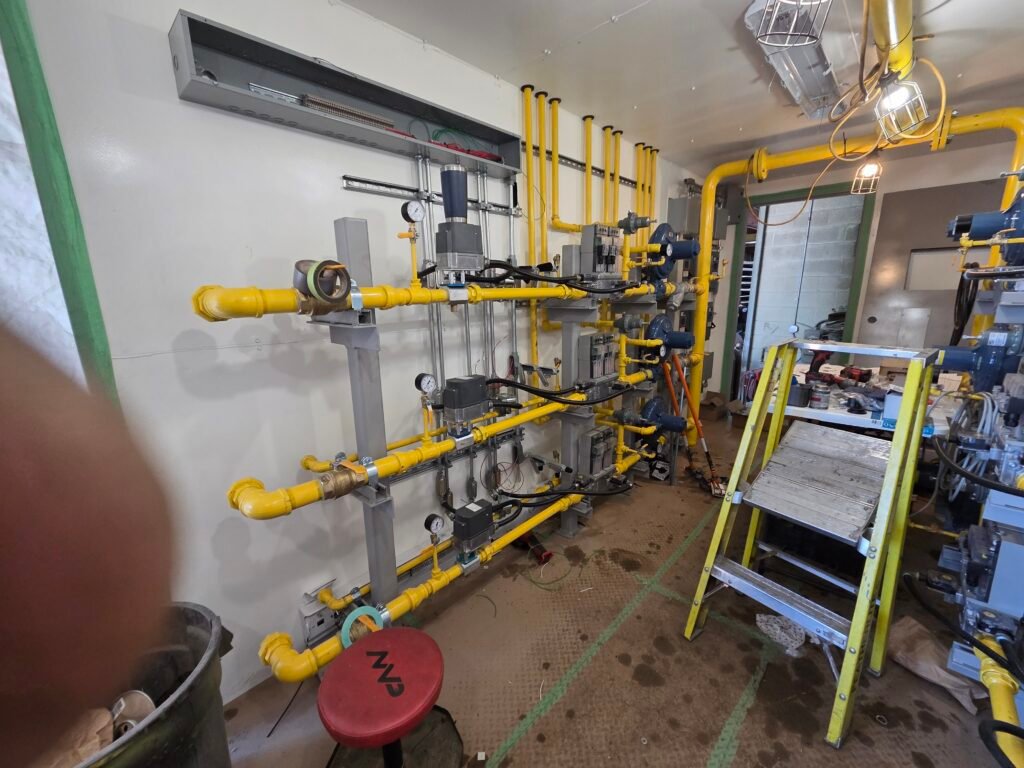
Engineered Fuel Train & Valve Train Piping Design
Complete Combustion provides licensed, P.Eng-stamped mechanical and fluid engineering for pre-packaged, skid-mounted, and field-assembled fuel trains. Engineered strictly to CSA B149.1 & B149.3, TSSA Field Approval requirements, and NFPA 86 standards, our valve train designs ensure precise fuel pressure regulation, reliable flow modulation, and code-mandated safety shutoff performance across USA and Canada.
Core Engineering Capabilities
1. Code-Compliant Safety Shutoff Configurations
- Dual Safety Shutoff Valves (SSOV): Sizing and specification of fast-closing, safety-rated shutoff valves wired in series for automatic fuel isolation.
- Proof-of-Closure (POC) & Position Indication: Integration of mechanical POC proof switches interlocked with the Burner Management System (BMS) to verify valve seating prior to pre-purge and ignition.
- Double Block and Bleed Venting: Inclusion of normally open, automatically operated atmospheric vent valves positioned between dual SSOVs to safely vent trapped gas to the outdoors during shutdown.
2. Differential Pressure Loss & Flow Calculations
- Component-by-Component Loss Modeling: Mathematical modeling of differential pressure drops across inlet manual isolation valves, strainers, main gas regulators, dual SSOVs, modulating control valves, and metering orifice plates.
- Velocity & Pipe Sizing: Sizing line diameters to keep gas velocities within industry limits, avoiding excessive noise, pipe erosion, and turbulent flow upstream of modulating control valves.
- Inlet Pressure Regulation: Selection of direct-acting or pilot-operated pressure regulators to stabilize fluctuating supply pressures and maintain tight lockup under zero-flow conditions.
3. Piping Flexibility, Support & Vibration Isolation
- Vibration Isolation Skids: Specifying stainless steel flexible braided metal hoses at strategic locations to prevent vibration transmission from blowers or process machinery into rigid gas piping.
- Structural Support Detailing: Heavy-duty unistrut clamping, structural pipe guides, and U-bolt restraints engineered to secure piping assemblies without inducing localized mechanical stress concentrations.
4. Mechanical Detailing & Shop Cut Lists
- Structural Skid Base Design: Welded structural channel and structural tubing frames with lifting lugs and anchor baseplates.
- Weldment Cut Lists: Exact cut length tables detailing pipe spool lengths, threading callouts, bevel angles, and flange weld specifications.
- Bill of Materials (BOM): Itemized procurement tables listing part numbers, pressure ratings, body materials, and approved manufacturers.
Supported Fuels & Firing Applications
- Natural Gas Fuel Trains: Standard and high-capacity natural gas trains from 0.5 MMBtu/hr to 60+ MMBtu/hr for boilers, dryers, kilns, and mine air systems.
- Liquefied Petroleum Gas (Propane): Bulk propane and vaporized LP gas delivery trains engineered for remote facilities, asphalt plants, and mine ventilation systems.
- Liquid Fuel & Oil Trains: Light fuel oil and heavy fuel oil trains complete with duplex strainers, pressure relief recirculation loops, and atomizing media trains.
- Oxy-Fuel & Cleaned-for-Oxygen Skids: Specialized piping assemblies degreased and cleaned for oxygen service, equipped with flashback arrestors and monel/brass trim.
Frequently Asked Questions
What is the difference between a CSA B149.1 and a CSA B149.3 fuel train?
CSA B149.1 governs general natural gas installation practices, whereas CSA B149.3 specifically dictates the mandatory safety controls, dual SSOV configurations, POC requirements, and venting arrangements for industrial combustion appliances requiring field approval.
What information do you need to size a valve train?
We require your available gas supply pressure (psig or in.w.c.), target burner firing capacity (MMBtu/hr, kW, or SCFH), fuel type, required burner manifold pressure, and preferred component brands.
Consult with Our Engineering Team
- Office: 33 Paddington Rd, Brampton, ON L6P 2E3
- Phone: +1 647 554 8108
- Email: info@completecombustion.ca